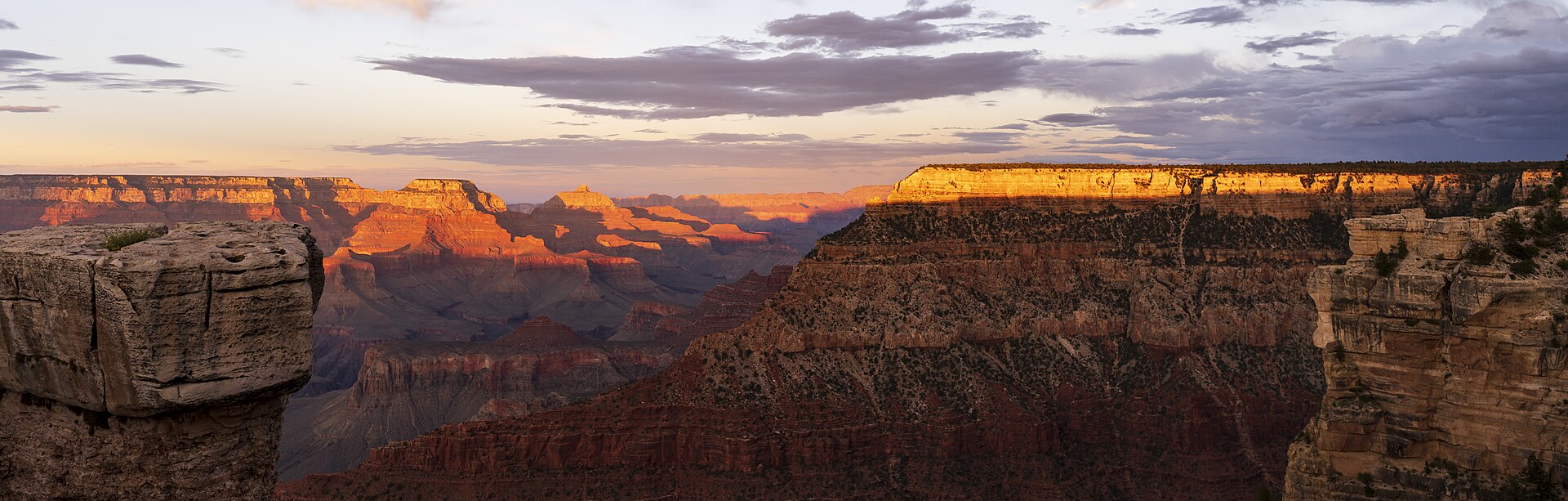

The Black Canyon of the Gunnison is the canyon that does not want you. Its walls are among the steepest in North America, its floor sees direct sun for a few minutes a day, its inner routes are not trails, and the river at the bottom drops faster than the Colorado through the Grand Canyon. It is also one of the quietest national parks in the West, and standing on its rim at dawn with no one else around is as close as you can get to looking straight into deep time.
What makes it different
The Gunnison River in western Colorado cut this gorge through Precambrian gneiss and schist, rock nearly two billion years old, hard, dark and fractured. Because the rock is so hard the canyon stayed narrow while it deepened: at its narrowest the river runs through a slot forty feet wide, and at the Chasm View overlook the walls are only eleven hundred feet apart while dropping nearly two thousand feet. The Painted Wall, streaked with pink pegmatite dikes, is the tallest cliff in Colorado. Through the park the river falls an average of thirty-four feet per mile, and in the steepest section more than two hundred.
The rims sit at about eight thousand feet. The South Rim, reached by a paved road from the town of Montrose, has the visitor center, a dozen overlooks along a scenic drive, and the main campground. The North Rim, reached by gravel road from the small town of Crawford, has a ranger station, a few overlooks and a small campground, and it sees a fraction of the visitors.
Rim walks for everyone
- Rim Rock Trail: an easy mile along the South Rim edge between the campground and the visitor center, with the best casual views into the canyon.
- Oak Flat Loop: two miles that dip just below the rim through Gambel oak and Douglas fir, the only maintained trail that gives a sense of being inside the canyon.
- Warner Point: a mile and a half at the end of the South Rim Road, out to a point with views west to the San Juans and down into the deepest part of the gorge.
- North Vista Trail: on the North Rim, three miles round trip to Exclamation Point and about seven to the top of Green Mountain, with the widest view in the park.
The scenic drive overlooks are all short walks from the road. Gunnison Point behind the visitor center, Chasm View and the Painted Wall overlook are the ones to catch in early light, when the far wall is lit and the river is still in shadow.
Going to the river
There are no trails to the bottom. There are routes, half a dozen unmarked scrambles down draws and gullies, and the park treats them as wilderness travel. They need a wilderness permit, issued in limited numbers; the process has changed in recent years, so check the park website for how permits are obtained this season. The most used is the Gunnison Route from the South Rim, which loses about eighteen hundred feet in a mile, with a long fixed chain to hold on the steepest section. The Tomichi and Warner routes on the same side are longer and looser. On the North Rim, S.O.B. Draw, Long Draw and Slide Draw are the named descents, and Slide Draw is the worst of them.
Three things define these routes. Loose rock, which you will send down onto anyone below you; poison ivy, which grows head high in the draws in summer and is impossible to avoid in shorts; and time, because a descent that took ninety minutes will take three hours to reverse, in sun, at altitude. Sturdy boots, long trousers, gloves for the chain, a helmet if you have one, and a very early start.
At the bottom you find a different world: a green ribbon of alder and box elder, cold clear water, boulders the size of houses, and the sky a narrow grey line overhead. Camping is allowed at the river on most routes with an overnight permit; a night down there is a night of noise from the water and near-total dark, with the sun arriving late and leaving early.
Water, weather and seasons
On the rim, water is available at the visitor center and the campgrounds in season; the South Rim supply is hauled in and shut off in the cold months. In the inner canyon the river is the only source; filter or treat it. Carry three litres for any inner-canyon day.
The season runs from May to October. Summer brings afternoon thunderstorms, often violent, and the rim is exposed; be off the points by early afternoon. September and October are the best weeks, with gold aspens on the drive in and stable weather. In winter the South Rim Road closes to vehicles beyond the visitor center and becomes a ski and snowshoe route; the North Rim road closes entirely.
A night on the rim
The South Rim campground has three loops, one with electric hookups, among oak and juniper a few minutes’ walk from the edge, with nightly fees in the range of what you would pay for a couple of coffees and a sandwich, a little more for the hookups. The North Rim campground is small, quiet and first-come. A third campground sits at East Portal, at river level at the bottom of a steep road with a sixteen percent grade that is closed to long trailers; it is the only place to camp beside the Gunnison without a scramble.
The rim is high, cold and dry, and the nights are extraordinary. This is a dark sky park with very little around it, and after the campground quiets you can walk to the rim, sit on the rock and listen to the river two thousand feet down while the stars come out. Bring a warm bag even in August. Dawn is the time to be at Gunnison Point with a coffee.
Common mistakes
- Treating a route as a trail: the Gunnison Route is a scramble with a chain, not a hike with a view.
- Shorts in the draws: the poison ivy rash lasts weeks.
- Starting down at ten: the climb out in afternoon sun at altitude is where rescues happen.
- Driving East Portal with a big rig: the grade and hairpins are serious; read the signs at the top.
- Skipping the North Rim: it is the better half if you have the time, and you will have the overlooks to yourself.
Worth the silence
The Black Canyon will never be crowded, because it does not offer the easy walk into beauty that Zion or Bryce do. What it offers instead is depth, darkness and quiet, a rim you can sit on for an hour without a sound but the river, and, for the fit and careful, a descent into a place that feels genuinely apart. Go in the fall, camp on the rim, and give it a dawn.
