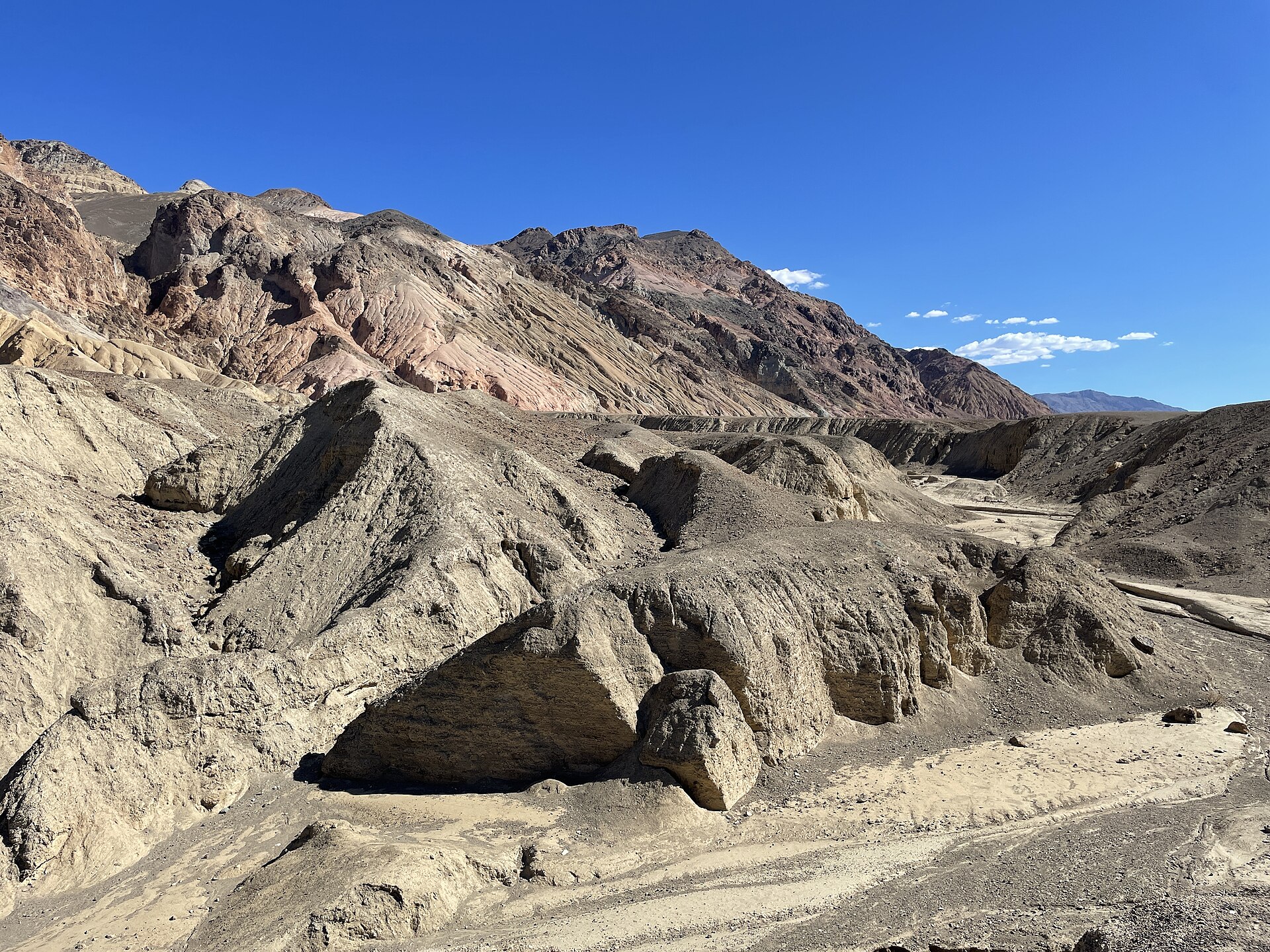

Death Valley has more canyons than it has names for them. Two of the best known, Mosaic and Golden, are short, easy to reach and worth every step. But the fans that spill off the Panamint and Black Mountains are cut by hundreds more, and the pleasure of the park in the cool months is picking one that has no sign, no trail and no one in it.
When to go, and when not to
The valley floor sits below sea level and summer highs routinely pass 115 degrees; the canyons, which trap heat and cut off any breeze, are worse. The hiking season is November through March, with April and October workable if you start at dawn. Winter days are often in the sixties and seventies with cold nights, which is exactly right for walking uphill on gravel. The park charges an entrance fee; check the park website for current rates and for road closures, which are frequent after storms. The floods that followed tropical storm Hilary in August 2023 closed the entire park for weeks and rewrote the floors of many canyons.
Mosaic Canyon
Mosaic sits above Stovepipe Wells at the end of a two-mile gravel road that most passenger cars manage. The first quarter mile is the reason people come: the canyon narrows to a chute of polished marble, grey and cream and swirled, smooth as a countertop where floods have scoured it for ages. Between the marble walls is the breccia that gives the canyon its name, angular chips of older rock cemented into a natural mosaic.
The narrows open into a broad gravel wash, and most visitors turn around there. Keep going. The canyon closes again about a mile and a half up, with a few short scrambles up dry falls that are easier than they look, and ends at a dryfall about two miles from the car that stops nearly everyone. Four miles round trip, an hour or two, no water anywhere, and full sun in the open sections.
Golden Canyon and the badlands
Golden Canyon is the busiest trail in the park and deserves to be. It starts just south of Furnace Creek and climbs gently through yellow mudstone badlands toward Red Cathedral, a wall of iron-stained cliffs. There was a paved road up this canyon until a flood in 1976 tore it out; pieces of asphalt still sit in the wash.
- Red Cathedral: About three miles round trip, with a short scramble at the end to a viewpoint under the cliffs.
- Gower Gulch loop: About four and a half miles. Go up Golden Canyon, cross the badlands ridge and come down Gower Gulch, a wider wash with an old borax prospect and a dryfall you skirt on the left at the mouth.
- Zabriskie Point connector: Roughly seven miles as a loop if you climb to the famous overlook and return by Gower Gulch. Best at sunrise, when the badlands go from grey to gold in a few minutes.
These are exposed trails. Even in January, carry two liters for the loop and a hat you would not want to be without.
The ones without names
Drive Badwater Road, or the West Side Road, or the dirt track toward Wildrose, and look up at the mountains. Every dark notch in the front is a canyon, and every canyon dumps onto an alluvial fan that runs down to the road. Most of them have no sign, some have a number on the geologic map and nothing else, and all of them are open to walking.
The method is simple. Park where the road crosses the fan, pick the notch above, and walk up the wash. The fan is the hard part: a mile or two of loose cobbles at a steady grade, with the mouth of the canyon never seeming to get closer. Then the walls close in and the day changes. You get narrows, dryfalls, chockstones, layers of limestone tilted on end, and the particular silence of a place that gets a handful of visitors a year.
Some rules of thumb for canyons without guidebook entries:
- Turn around at the first dryfall you are not sure about. Climbing up is always easier than climbing down, and the exit is the same way you came.
- Note every fork. Canyons on the Black Mountains side branch constantly and the branches look identical from below. A photo or a cairn at each junction is cheap insurance.
- Treat the fan as part of the hike. It adds distance, sun and time to both ends of the day.
- Carry more water than the distance suggests. A liter per hour in cool weather is not excessive on loose gravel.
If you want a middle path between the famous trails and pure exploration, Fall Canyon north of Titus Canyon, Sidewinder Canyon south of Badwater with its dark side slots, and Marble Canyon out of Cottonwood Canyon are all named, mapped and lightly trailed, and all give the same feeling of being somewhere the park does not manage.
Camping
Furnace Creek campground takes reservations in the cool season and has water and flush toilets; Texas Springs and Sunset nearby are first-come and cheaper; Stovepipe Wells is handy for Mosaic. Mesquite Spring, in the north, is quiet and dark. Wildrose and Emigrant are free, high and cold in winter. Fees are modest; check the park website. Lodging inside the park runs from roughly 150 to well over 400 dollars a night, and fuel at the in-park stations is the most expensive you will buy in California.
Backcountry car camping is allowed on many dirt roads once you are at least a mile from a paved road or a developed area, and the free permit rules have been changing; check the park website before you go. Camp at the mouth of a fan and you can walk into a canyon at first light with nothing but a daypack. Camp inside a canyon and you are sleeping in a drainage, which you should not do.
Flash floods in a place with no rain
Death Valley averages two inches of rain a year, and most of it arrives all at once. A storm on the Panamints can send a slurry of mud and boulders down a canyon you are standing in while the valley floor stays dry. If clouds are building over the mountains, stay out of the narrows. If you are already in and it starts to rain, get out or get high. The floods that rearranged Mosaic and Golden happened in single afternoons.
The habit of looking up
Once you have walked a few nameless canyons, you cannot drive Badwater Road without reading the mountains for the next one. The park is nearly three and a half million acres and the marked trails cover a tiny part of it. Take Mosaic and Golden for their polish and their color, and then take the notch above the road that nobody else is looking at.
