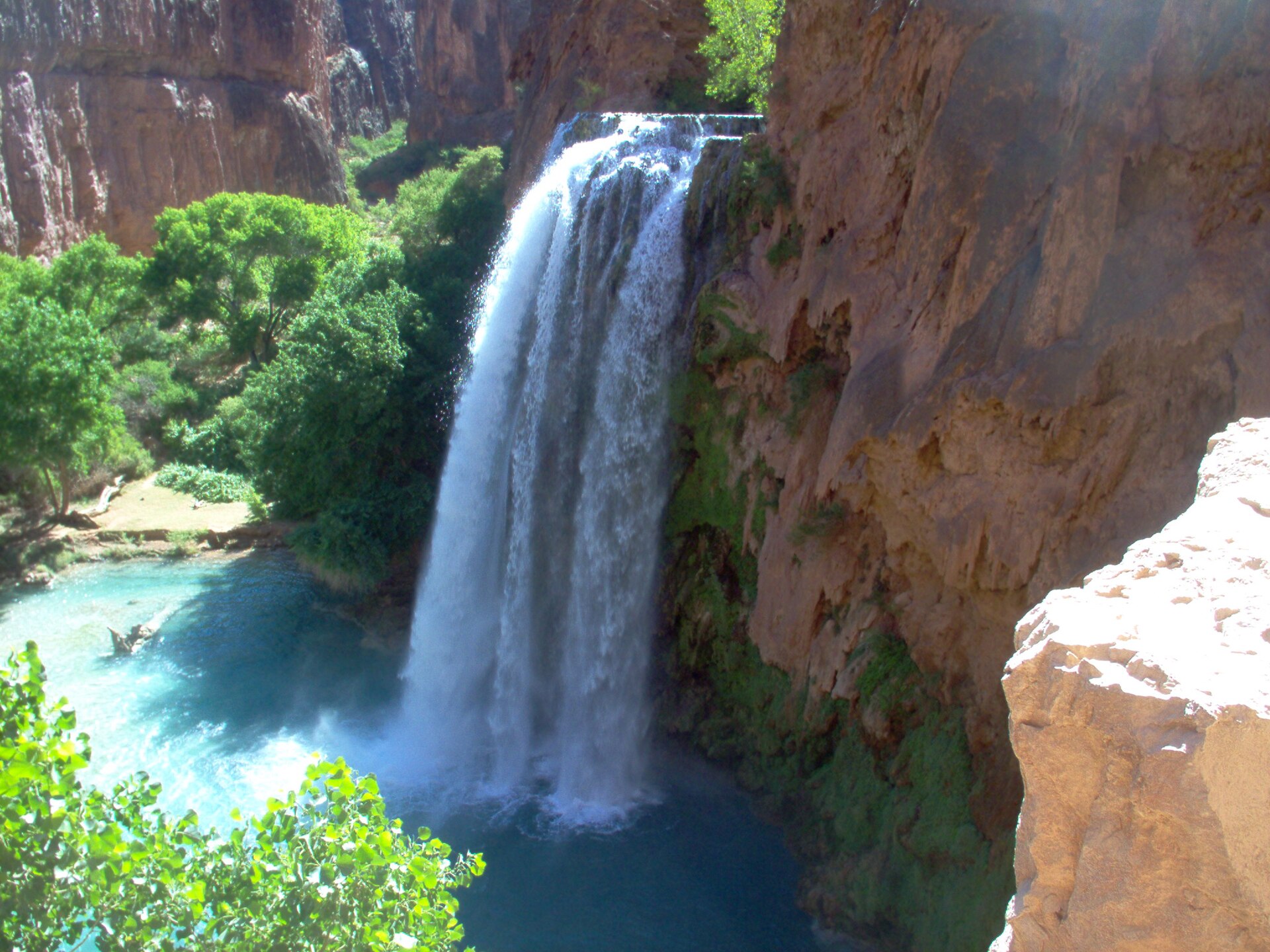

Every year the photos come around again: blue-green water pouring over red rock into a pool that looks dyed. The photos are accurate. What they leave out is that the falls sit on the Havasupai Reservation, not in Grand Canyon National Park, that you need a permit that is hard to get, that the hike in is ten miles of desert with a heavy pack, and that the campground is a mile of tents along a creek. Here is what the trip actually involves.
The permit is the trip
The Havasupai Tribe controls all access. There is no day hiking, no walking in without a reservation, and no camping outside the designated campground or the lodge in Supai village. Permits are sold through the tribe’s official reservation system, released in a block early in the year for the whole season, and the popular dates disappear within hours. Stays are sold as fixed multi-night packages, typically three nights, priced per person, and the cost runs into the hundreds of dollars for the stay. Check the official reservation site for the current release date, the prices and the rules, and be wary of anyone reselling permits outside the official transfer system.
The season runs roughly February through November. The campground closes over the winter. Summer is brutally hot in the canyon bottom and the monsoon brings flood risk; March to May and October are the months experienced hikers aim for. Whatever your dates, note that the reservation belongs to the named permit holder, who must be present with identification.
Getting to Hualapai Hilltop
The trailhead is at the end of Indian Road 18, about sixty miles of paved but empty road north from Route 66 between Peach Springs and Seligman, Arizona. There is no water, no fuel and no store at the hilltop, only a parking lot on the rim, pit toilets and the helicopter pad. Most people stay the night before in Peach Springs, Seligman or Kingman, where motel rooms run somewhere between 80 and 200 dollars depending on the season, and drive up in the dark to start walking at first light.
The hike in
From the hilltop, the trail drops about a thousand feet in the first mile and a half of switchbacks and then follows Hualapai Canyon downstream. The wash is gravel and sand, walled in and shadeless by mid-morning, and it goes on for six miles before it meets Havasu Creek. Supai village is eight miles from the trailhead; the campground is two miles further, past the check-in, past Fifty Foot Falls and the two Navajo Falls that formed after the 2008 flood rearranged the creek, and finally past Havasu Falls itself.
There is no water on the trail until the village. In April that means three liters a person; in June it means starting before dawn and carrying four or more. The elevation loss on the way in is around two thousand feet, which you pay back on the way out, and the last mile and a half of switchbacks in afternoon heat is where people get into trouble. Plan the exit for the coolest part of the day.
Pack mules and a helicopter carry gear for a fee. The treatment of the mules has been controversial for years, and the helicopter schedule is unreliable; the simplest choice is to carry a pack you can actually carry. Twenty-five to thirty pounds with water is a realistic target for three nights in warm weather.
The campground
The campground stretches about a mile along Havasu Creek between Havasu Falls and the lip of Mooney Falls. There are no assigned sites; you walk in and take a flat spot under the cottonwoods, ideally on the far side of the creek from the trail and well above the water. Sites near the top fill first; the quieter ground is downstream. Composting toilets are spaced along the mile. Drinking water comes from a spring piped to a spigot near the top of the campground, and most people drink it untreated, though a filter costs nothing to carry.
The creek is about seventy degrees year round, milky blue from dissolved limestone, and it builds travertine terraces everywhere it slows down. Campfires are not allowed. Ravens and squirrels will open a pack in minutes, so hang food in a rodent-proof bag from the cables at many sites. Nights are loud with water and quiet with everything else; there is no cell service anywhere in the canyon, and none at the hilltop worth relying on.
Mooney, Beaver and the confluence
Mooney Falls, at the bottom of the campground, is nearly two hundred feet high, and the descent to its base is the part of the trip that surprises people: two short tunnels through the travertine, then a near-vertical section of chains, bolts and wooden ladders slick with spray. It is doable for anyone comfortable with heights and a firm grip, and it is not a place for flip-flops or a big pack. Go early before the line forms.
Below Mooney the trail continues about three miles to Beaver Falls, crossing the creek several times through waist-deep water, then another five to the confluence with the Colorado River. Beaver Falls is a good day; the confluence is a long one, and the tribe requires you to be back in the campground before dark. Check the current rules on how far downstream you can go.
Flash floods are not hypothetical
Havasu Creek has flooded the campground in 2008, 2018, 2022 and 2024, with campers evacuated by helicopter more than once. The canyon drains a large area of the plateau, and rain you never see can put the creek several feet higher in an hour. The tribe posts warnings and closes the campground when forecasts are bad, and in the monsoon months of July through September you should expect the possibility of an evacuation or a cancelled trip. Camp high, know the route to higher ground from your tent, and pay attention to what the rangers and locals tell you.
What it costs, honestly
Between the permit package, fuel for a remote drive, one or two motel nights and food, a three-night trip for one person usually lands somewhere in the range of 500 to 900 dollars, and more if you use the mules or the helicopter. That is a lot for a campsite. It is also one of the few places on earth where you can swim below a waterfall like that with a few hundred other people instead of a few thousand.
Worth it, with the right expectations
Go expecting a hot, unglamorous hike, a crowded but civil campground and a village with its own rules. Then let the water do what the photos promised. The falls are real. So is everything around them.
