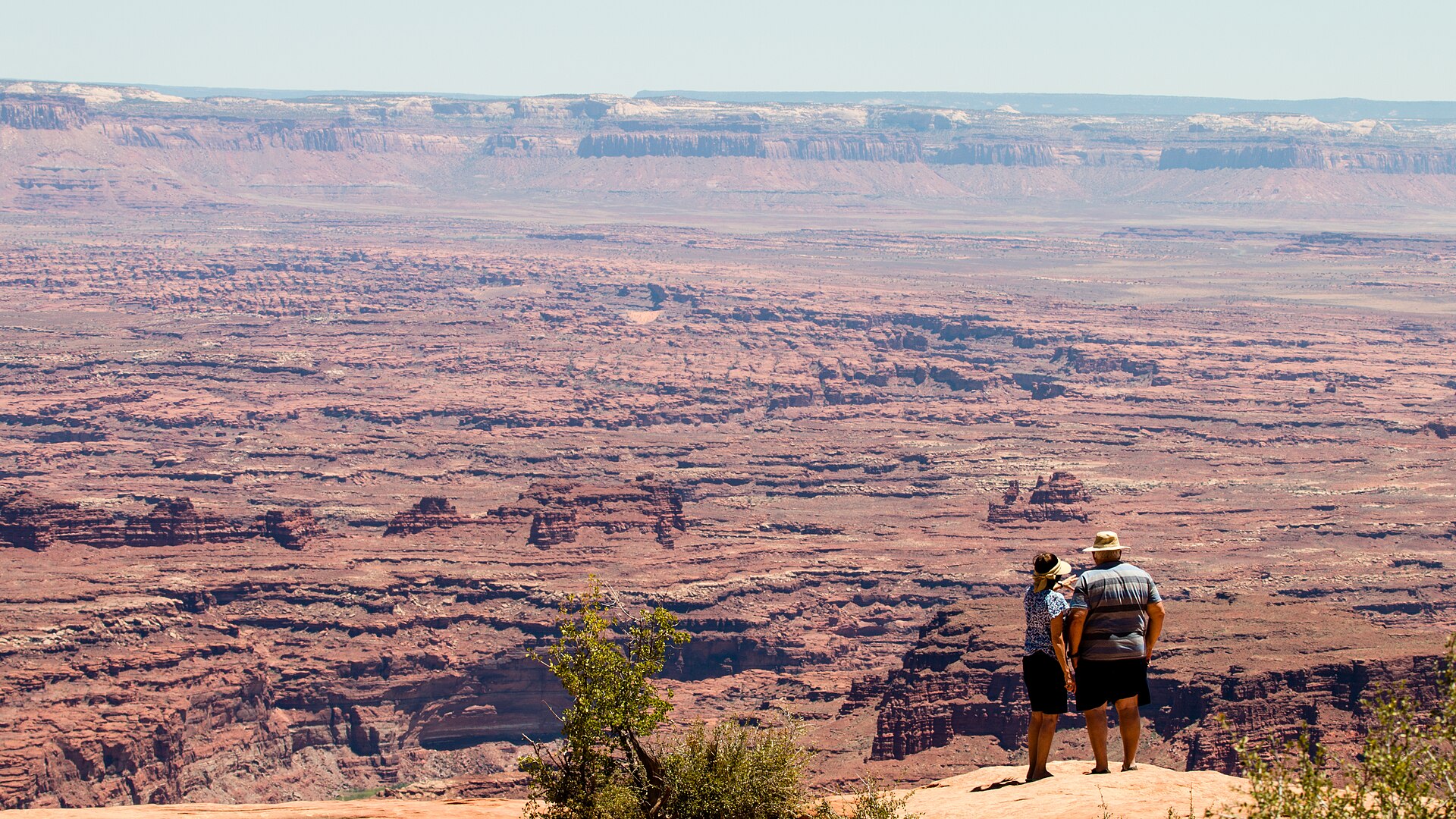

The Needles District is the part of Canyonlands that rewards walking. Island in the Sky is a drive-up viewpoint; the Maze is a multi-day expedition; the Needles, in the southeast corner of the park, is a tangle of sandstone spires, grabens and grassy parks that you can see properly in two nights on foot. If you have never backpacked in the desert, this is one of the best places on the Colorado Plateau to start.
Getting there and getting oriented
The district is about seventy-five miles from Moab: south on US-191, then west on a paved state road that passes Newspaper Rock, a panel of petroglyphs worth twenty minutes, and drops through a valley of red cliffs to the park entrance. The visitor center is the last place to fill water bottles, buy a map and ask about conditions.
Almost every backpacking route begins at the Elephant Hill trailhead, at the end of a short gravel spur past the Squaw Flat campground. The parking lot doubles as the start of the notorious Elephant Hill four-wheel-drive road, and hikers sometimes end up on the jeep track by mistake; the foot trail leaves from the far end of the lot and climbs slickrock immediately.
A two-night loop that works
Here is the loop we recommend for a first trip, about eighteen miles in all with a lot of ups and downs but nothing technical.
Day one takes you from Elephant Hill over a slickrock pass into Elephant Canyon and up into Chesler Park, a broad grassland ringed by the red-and-white banded spires that give the district its name. It is roughly three and a half miles to the first of the Chesler Park campsites, which sit on the edges of the meadow among the rocks. Set up, then walk the Joint Trail without a pack: a half mile of corridors so narrow you turn sideways, opening into a hidden pocket of the park. Camping inside Chesler is limited to a handful of designated sites, and they are the most sought-after in the district.
Day two is the long one. Drop back into Elephant Canyon and follow it upstream to Druid Arch, a massive angular span at the head of the canyon that requires a short scramble and a ladder-assisted step at the end; the round trip from Chesler is six to seven miles. Then descend Elephant Canyon and cross into Squaw Canyon or Big Spring Canyon to a second campsite. These canyon-bottom sites are shadier, have cottonwoods, and in spring may have pools.
Day three is an easy walk out to Squaw Flat, a mile or so from your car, or a slightly longer return to Elephant Hill via the connector trail. Navigation throughout is by cairns on slickrock and worn track in the washes; the trails are well marked, but pay attention at every junction and carry a paper map.
Permits and campsites
Overnight stays in the Needles backcountry require a permit, and for Chesler Park in spring and fall you should reserve months ahead through the park’s online reservation system. Each permit is tied to specific numbered sites for specific nights, so plan the loop before you book. Walk-up permits sometimes exist for the less popular canyons, but do not count on them in April or October. There is a per-permit and per-person fee; check the park website for the current amounts and the reservation windows.
Group size is limited, fires are prohibited, and human waste must be packed out in many zones; the park will tell you which rules apply to your sites. Squaw Flat, the front-country campground near the trailhead, has a couple of dozen sites, water in season and a nightly fee in the range of a fast-food dinner for two. It fills by mid-morning in the busy months.
Water, heat and the timing of a trip
Water decides everything in the Needles. Elephant Canyon and Big Spring Canyon carry intermittent pools after wet winters and dry to nothing by June. Chesler Park has none. Plan to carry all your water, a gallon per person per day in shoulder season and more in heat, and treat any pool you find as a bonus rather than a plan.
The seasons are simple. Late March through May and mid-September through October are the windows: days in the sixties and seventies, nights that can freeze, and the lowest flood risk. Summer is over a hundred in the canyons with no shade, and the monsoon in July and August sends flash floods down the same washes the trails follow; canyon-bottom campsites are exactly where you do not want to be during a storm. Winter is quiet and often lovely, but ice on the slickrock passes makes some connectors dangerous and the nights are long and cold.
- Carry more water than the mileage suggests: slickrock and sand make short distances slow.
- Watch the sky to the west: storms arrive over the Maze and hit the Needles an hour later.
- Stay off the cryptobiotic soil: the black, crusty ground between the rocks takes decades to recover from one footprint.
A night in Chesler Park
Evening in Chesler is the reason to bother with the permit. The spires around the meadow catch the last sun and glow like coals long after the grass has gone grey. The wind drops. Ravens patrol the campsites at dusk and will open a pack in seconds, so everything with a smell goes in the tent or a sealed bag. There are no fires, so dinner is a stove behind a boulder and then a long, cold, silent dark. The Needles is far from any town and the sky is as black as it gets in the lower forty-eight; the Milky Way rises over the spires and you will hear nothing but your own breathing and, occasionally, a great horned owl.
Mornings are cold enough for gloves in October. The sun comes over the rim of the park late, and when it does the meadow steams for a few minutes. Pack up slowly; there is no rush in the Needles that the desert does not punish.
Common first-trip mistakes
- Booking too late: Chesler sites in April go fast. Have a second loop in mind.
- Treating the loop as a single trail: it is a chain of short trails and junctions. Check the map at every cairn cluster.
- Arriving in the afternoon: the first slickrock pass in full sun with a full pack is a rough way to start.
- Trusting last month’s water report: conditions change weekly. Ask at the visitor center and then carry more anyway.
- Driving the Elephant Hill road by accident: if you are in a sedan and the road turns to ledges, you missed the hikers’ lot.
Worth the permit
The Needles gives you real desert backcountry with real trails, a meadow among spires that most park visitors never see, and nights of a silence you will remember. Do it in two nights, do it in the right season, and it will spoil you for the rest of the Plateau.
