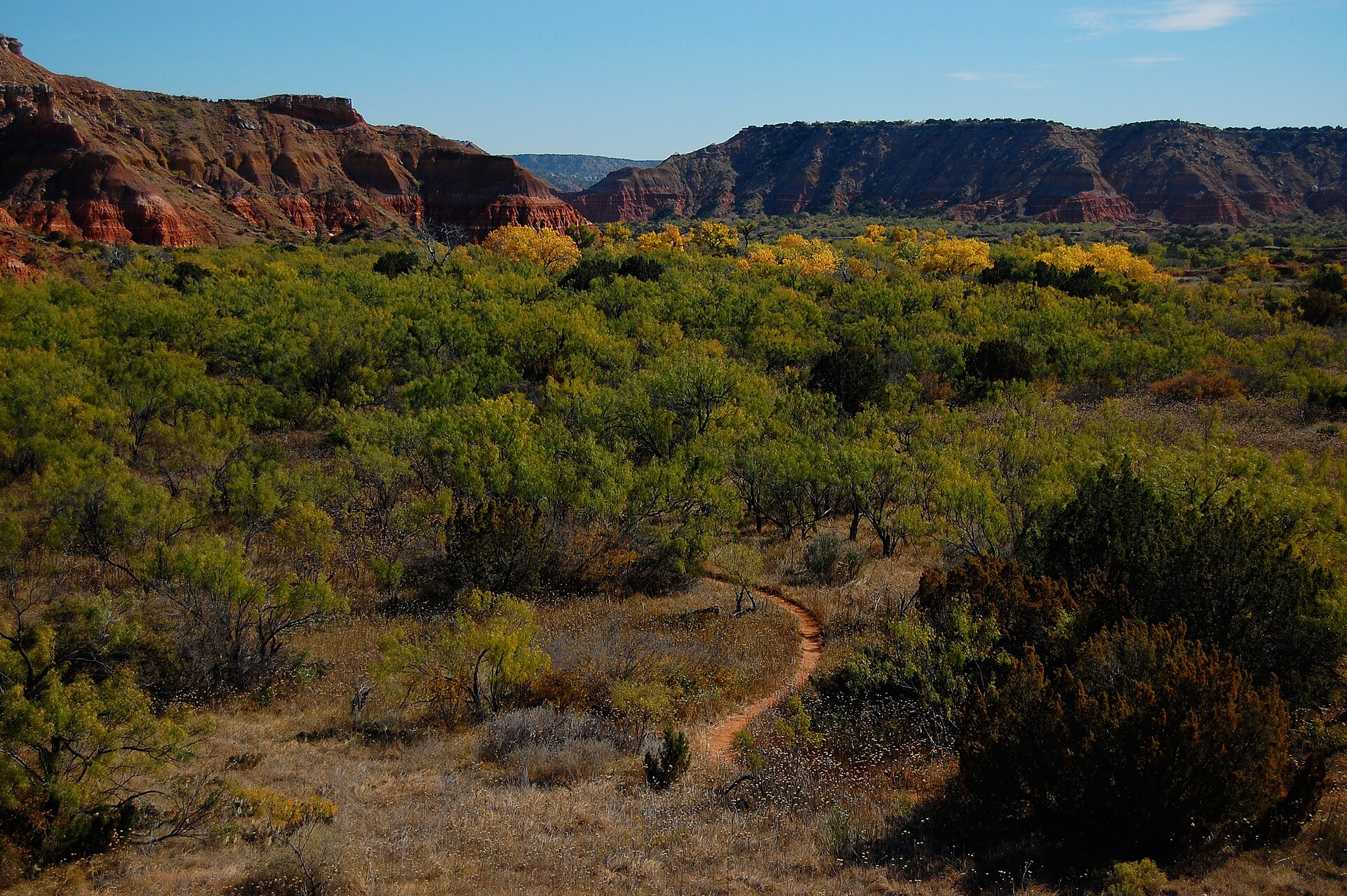

Most people who love the canyons of the Southwest have never been to the Texas Panhandle, and most people driving through the Panhandle on Interstate 40 have no idea that the second-largest canyon in the country opens up twenty-five miles from Amarillo. Palo Duro Canyon is about a hundred and twenty miles long, up to twenty miles wide and around eight hundred feet deep, cut by the Prairie Dog Town Fork of the Red River through a plateau so flat that you do not see the canyon until you are standing on the rim. It is worth the drive.
Where it is and how it looks
Palo Duro Canyon State Park protects the upper end of the canyon, south-east of the town of Canyon. A paved park road built by the Civilian Conservation Corps in the 1930s drops off the rim in a series of tight curves and runs about fifteen miles along the canyon floor, crossing the river on several low-water crossings that close after heavy rain. Everything happens along this road: the trailheads, the campgrounds, the cabins and the amphitheater where an outdoor musical plays on summer nights.
The colours are the reason to come. Four rock formations stack up in the walls: the deep red mudstones of the Quartermaster Formation at the bottom, the striped lavenders and yellows of the Tecovas above, the sandstone ledges of the Trujillo and the pale caprock of the Ogallala on top. Where erosion has carved the lower formations into fluted pleats the locals call them the Spanish Skirts, and where a harder cap protects a column you get the park’s emblem, the Lighthouse.
The trails
The park has more than thirty miles of trail, shared among hikers, mountain bikers and, on some routes, horses.
- Lighthouse Trail: the signature walk, about six miles round trip on a gentle grade to the base of the Lighthouse, followed by a short, steep scramble to the saddle beside it. Mostly unshaded. Start early and carry more water than feels reasonable.
- Rock Garden Trail: the park’s big climb, roughly six hundred feet from the canyon floor to the rim through boulders and juniper, with the best views back over the whole canyon.
- Givens, Spicer and Lowry Trail: a rolling loop through the heart of the park that links several other routes and lets you build a day of whatever length you like.
- CCC Trail: a short, steep route from the visitor center on the rim down to the canyon floor, following the old work road, with the history of the park written in the stonework.
- Juniper Cliffside and Capitol Peak: quieter routes along the eastern wall and around a prominent butte, good for a second morning.
Mountain biking is a serious thing here, and some of the loops are among the best flowing singletrack in Texas. If you hike them, expect to step aside.
Heat, water and the river
The Panhandle is high, dry and windy, and the canyon floor is hotter than the rim by a wide margin. Summer afternoons routinely pass a hundred degrees, there is little shade on the popular trails, and the park has lost hikers to heat on the Lighthouse Trail. Between June and September, walk in the first three hours of daylight and be back at the car before noon, or wait for the last two hours of light. The park posts heat advisories and sometimes closes trails; take them seriously.
There is no water on any trail. Carry at least a litre for every hour you plan to be out and drink it. Fill up at the visitor center or the campgrounds.
The Red River fork looks like a trickle most of the year, but the canyon drains a large piece of the plateau and storms upstream send it up fast and muddy. The low-water crossings on the park road flood and close, and the campgrounds on the canyon floor have been evacuated in bad years. If you camp in the bottom during the spring or late-summer storm seasons, know where the road out is and keep an eye on the sky over the rim.
When to go
October through April is the season. Fall brings cool mornings, gold cottonwoods along the river and clear light on the red walls. Winter is mild by northern standards, with cold nights, occasional snow that melts by noon and empty trails. Spring is windy and green, with wildflowers in a wet year and the first heat by May. Summer is for the musical, the cabins and dawn walks only.
Weekends and school holidays fill the park, and day-use entry is sometimes capped. Reserve everything, including day passes, through the state parks system ahead of time.
A night in the canyon
There are several campgrounds on the canyon floor with water and electric hookups, a primitive tent area, and a set of stone cabins on the rim and in the canyon built by the same CCC crews who built the road. Nightly fees run from a modest amount for a primitive site to the price of a mid-range motel room for a cabin, plus a per-person entrance fee; check the state parks website for the current numbers and book early for the cabins, which sell out months ahead.
Evening in Palo Duro is loud and then very quiet. Wind pours down the canyon at dusk, rattles everything, and dies as the walls cool. The cliffs go from red to purple to black, roadrunners cross the road in front of the campsite, and after dark the coyotes start up from three directions. Aoudad, the North African sheep introduced decades ago, clatter on the ledges above camp. The stars are good, not quite Utah good, and mesquite smoke from the neighbours drifts through the site. Mornings are cool even in July, and the first light on the Spanish Skirts is the best half hour of the day.
Common mistakes
- The Lighthouse at noon in July: the single most common way to need a ranger.
- Sandals and a bottle of water: the trails are rock, sand and cactus, and one bottle is not enough for anything.
- Underestimating the scramble: the last hundred feet to the Lighthouse saddle is hands-on and loose; turn around if it feels wrong.
- Ignoring the wildlife: western diamondback rattlesnakes are common in warm months. Watch where you put your hands.
- Arriving without a reservation on a Saturday: you may be turned away at the gate.
Worth the drive
Palo Duro is not Utah and does not try to be. It is a Texas canyon: big, red, windy, generous with its trails and blunt about its heat. Come in the cool months, walk at first light, and give yourself a night in the bottom to hear the coyotes. You will plan the next trip on the drive home.
